
Strength360
Strength360
Case Study
Even if today seems fine, tomorrow could present unexpected challenges. Leverage your strengths. Address your weakness. Strengthen your performance.
1. Explore What Makes Talent Unique
Begin by examining their Strength360 Assets, paying attention to both the highest and lowest scoring assets. These are what truly define their uniqueness. In this example, we’ll try to discover the uniqueness of SK, a consultant in an HR consulting company.
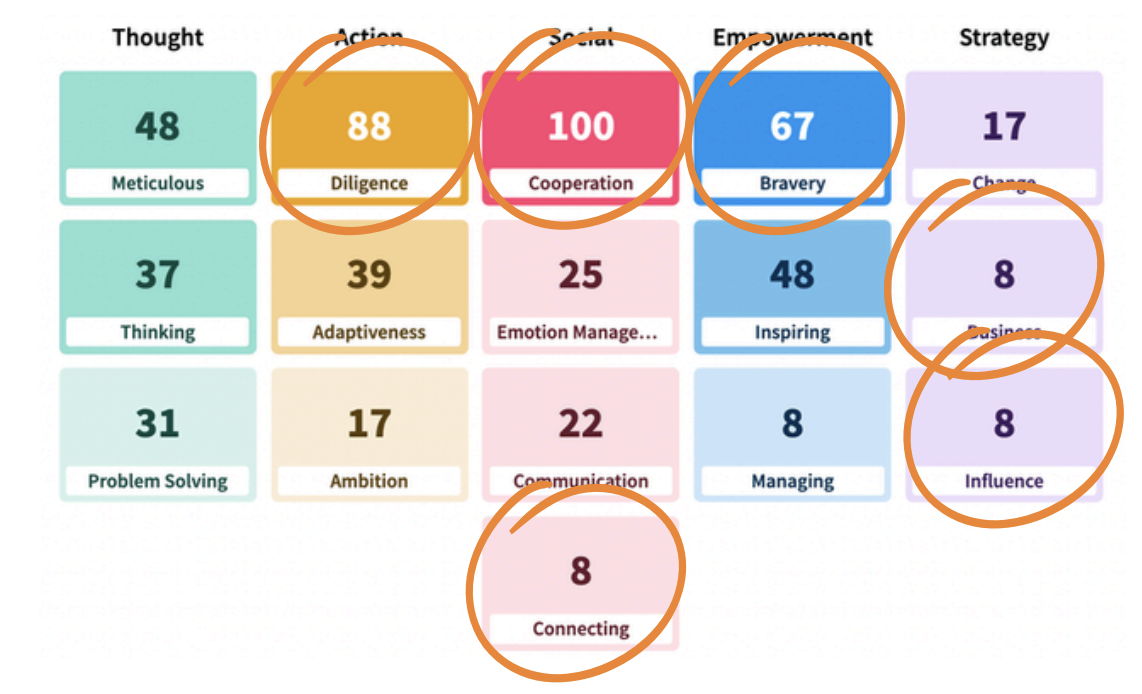
By looking at her assets, her most prominent asset is Cooperation, followed by Diligence and Bravery. This suggests that SK naturally excels in collaborating with others, works diligently, and maintains her confidence and honesty. In contrast, her weaker assets are Connecting, Managing, Business, and Influence.
What sets her apart is the intriguing contrast within the Social domain, while Cooperation is her strongest asset, one of her weakest assets is Connecting. This suggests that although she thrives in collaboration, her interactions are mostly limited to her close circle. Her challenge lies in building social connections beyond her immediate network through effective networking and deeper relationships.
By looking at her assets, her most prominent asset is Cooperation, followed by Diligence and Bravery. This suggests that SK naturally excels in collaborating with others, works diligently, and maintains her confidence and honesty. In contrast, her weaker assets are Connecting, Managing, Business, and Influence.
What sets her apart is the intriguing contrast within the Social domain, while Cooperation is her strongest asset, one of her weakest assets is Connecting. This suggests that although she thrives in collaboration, her interactions are mostly limited to her close circle. Her challenge lies in building social connections beyond her immediate network through effective networking and deeper relationships.
2. Delving Deeper into Talent’s Asset
The next step is to delve deeper into understanding the talent's uniqueness. As we know, her most prominent asset is cooperation, followed by diligence and bravery. By further analyzing SK’s results—particularly the mixed ones—like bravery, we can gain a better understanding of her distinct qualities.

Bravery comprises three strengths: Confidence, Honesty, and Courage. In her case, her Honesty level is realized (RE), meaning she has the enthusiasm and confidence to act honestly. However, her Confidence and Courage are at a learned (LE) level, indicating that she does not naturally enjoy acting confidently or courageously, but she makes an effort to do so, even though it can be draining.
Thus, her bravery relies on acting honestly, supported by her courage and confidence. However, this can be draining, especially in challenging situations that demand critical and honest responses.
Bravery comprises three strengths: Confidence, Honesty, and Courage. In her case, her Honesty level is realized (RE), meaning she has the enthusiasm and confidence to act honestly. However, her Confidence and Courage are at a learned (LE) level, indicating that she does not naturally enjoy acting confidently or courageously, but she makes an effort to do so, even though it can be draining.
Thus, her bravery relies on acting honestly, supported by her courage and confidence. However, this can be draining, especially in challenging situations that demand critical and honest responses.
REMEMBER. Each asset consists of 3 to 4 strengths (see the strength360 assets table). These strengths determine the asset's unique dynamics and interplay, making it distinct to the talent.
3. Draw a Conclusion
By integrating both broad and in-depth analysis—the evaluation of Strength360 assets and the interaction of asset building blocks—we can conclude what makes talent distinctive, their inherent approach, and their potential blind spots.
In SK's case, she naturally excels in collaborating with others, works diligently, and maintains her confidence and honesty. However, her bravery may be confined to acting straightforwardly in less demanding situations.
Her interactions are mostly limited to her close circle. Her challenge lies in building social connections beyond her immediate network through effective networking and fostering deeper relationships. She has also struggled in roles that require a strategic approach.
In SK's case, she naturally excels in collaborating with others, works diligently, and maintains her confidence and honesty. However, her bravery may be confined to acting straightforwardly in less demanding situations.
Her interactions are mostly limited to her close circle. Her challenge lies in building social connections beyond her immediate network through effective networking and fostering deeper relationships. She has also struggled in roles that require a strategic approach.
4. Identifying Relevant Assets for Talent Success
The second step in the VOS Framework, the Vision, is understanding that not every asset is relevant for a particular role, especially for talent to succeed in that role. The process of determining the relevant assets begins by envisioning the future, what is needed for success in that role. The assets required for a Consultant to succeed and thrive might differ from those needed by a mere manager.
SK works as a consultant in an HR consulting company. We can argue that to be successful as a consultant, one needs the strengths to solve problems, influence stakeholders, and manage the changes. Thus, the required relevant assets are Problem-solving, Influence, and Change.
SK works as a consultant in an HR consulting company. We can argue that to be successful as a consultant, one needs the strengths to solve problems, influence stakeholders, and manage the changes. Thus, the required relevant assets are Problem-solving, Influence, and Change.
5. Finding Overlapping Assets & Strengths
From the previous section, we've concluded that SK's uniqueness comes from her natural approach to cooperation, diligence, and bravery, as well as her blind spots in strategic areas such as change, business, and influence.

When comparing her uniqueness and assets, we might not notice some overlap. However, among her Top 10 Strengths, Problem Solving ranks first. Further analysis reveals that her Change Advocacy is underdeveloped—remember, the devil is in the details. These two are the foundation of Problem Solving and Change assets, respectively. While they can be used as the basis for optimizing her roles as a consultant, the Influence asset is her blind spot and consists of weaknesses.
Understanding her relevant assets and uniqueness is the key step in leveraging her strengths and addressing gaps. For management, this understanding will benefit her performance and may help her achieve her true potential.
When comparing her uniqueness and assets, we might not notice some overlap. However, among her Top 10 Strengths, Problem Solving ranks first. Further analysis reveals that her Change Advocacy is underdeveloped—remember, the devil is in the details. These two are the foundation of Problem Solving and Change assets, respectively. While they can be used as the basis for optimizing her roles as a consultant, the Influence asset is her blind spot and consists of weaknesses.
Understanding her relevant assets and uniqueness is the key step in leveraging her strengths and addressing gaps. For management, this understanding will benefit her performance and may help her achieve her true potential.
6. Leveraging Strengths and Addressing Gaps
The VOS Framework combines optimization and developmental strategies, improves effectiveness by addressing weaknesses and leveraging strengths to achieve unique competitive advantages. By focusing on relevant assets and uniqueness, talent can develop what truly matters for success in their role, leveraging strengths while addressing key gaps, the third step in the VOS Framework.
In this case, SK needs to enhance her problem-solving and change management skills to optimize her role as a consultant. She has Problem-solving as realized and her Change Advocacy as underdeveloped. By focusing on these areas, they can serve as the foundation for her problem-solving and change management assets. A well-tailored development plan is essential to achieving desirable outcomes and improving her key function as a consultant.
On the other hand, she naturally excels in collaboration, diligence, confidence, and honesty. While these may not be the most relevant assets for a consultant, they enhance her effectiveness, particularly in client collaboration, providing honest feedback, and diligently delivering solutions.
Addressing weaknesses and leveraging strengths are powerful tools for enhancing potential across roles and situations.
In this case, SK needs to enhance her problem-solving and change management skills to optimize her role as a consultant. She has Problem-solving as realized and her Change Advocacy as underdeveloped. By focusing on these areas, they can serve as the foundation for her problem-solving and change management assets. A well-tailored development plan is essential to achieving desirable outcomes and improving her key function as a consultant.
On the other hand, she naturally excels in collaboration, diligence, confidence, and honesty. While these may not be the most relevant assets for a consultant, they enhance her effectiveness, particularly in client collaboration, providing honest feedback, and diligently delivering solutions.
Addressing weaknesses and leveraging strengths are powerful tools for enhancing potential across roles and situations.
7. Overdrive: Too much of a good thing.
While it's beneficial to use strengths, they must be applied appropriately. Overdrive occurs when individuals excessively or inappropriately use their strengths. It typically happens in strength that has multiple "over" aspects. For instance, someone with only over-enthusiasm is less likely to experience overdrive than someone with both overconfidence and over-enthusiasm.
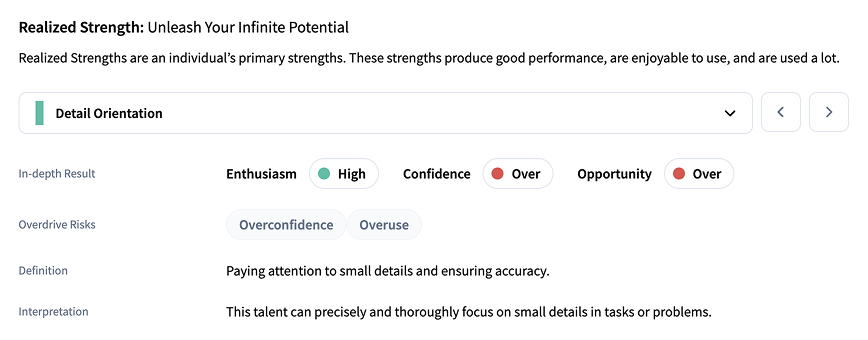
In Planning, SK has an overdrive risk: overconfidence. This tendency may cause her to overestimate her planning skills, potentially resulting in insufficient contingency plans during her project consultations. Therefore, addressing this issue should be added to her optimization list and considered carefully.
In Planning, SK has an overdrive risk: overconfidence. This tendency may cause her to overestimate her planning skills, potentially resulting in insufficient contingency plans during her project consultations. Therefore, addressing this issue should be added to her optimization list and considered carefully.